


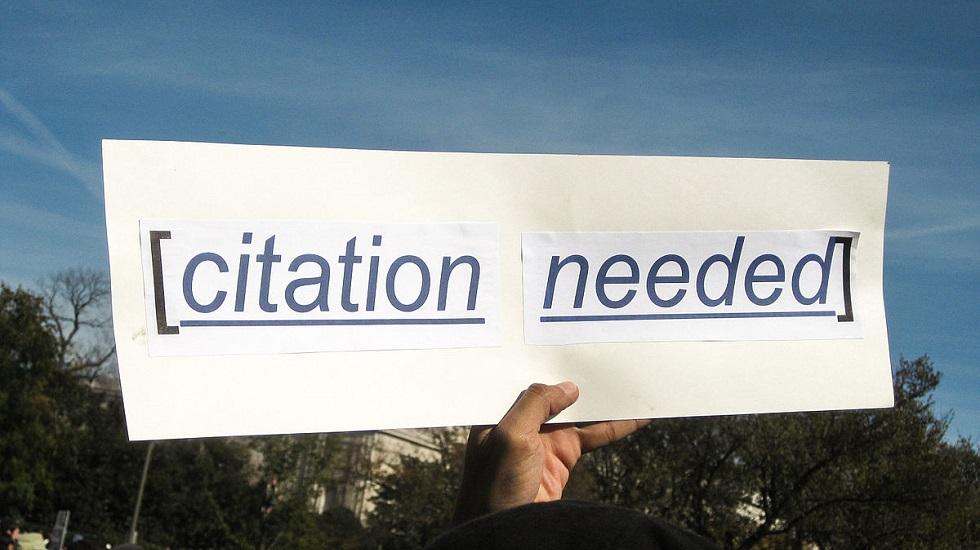
The ability to find, evaluate, and cite high-quality sources is imperative. Here’s how I teach these skills in my courses.
After nearly a decade of teaching undergraduate economics, I’m no longer surprised at the number of students I encounter who don’t know how to find, evaluate, or cite high-quality sources when researching a topic.
These skills form the basis of sound academic scholarship. But they’re also essential to participating in a successful democracy. And yet, I’ve found that many students lack these critical abilities. Here’s how I try to teach these core skills in my courses.
Why proper sourcing is so important
A key element of both academic and political discourse is the ability to form logical arguments based on accurate information. This ability, in turn, relies on being able to find and reference credible sources.
If students don’t know how to critically evaluate sources, they might base their thinking on faulty information. In the academic world, this will result in poor scholarship. In the real world, the implications are even worse: Students could make bad choices when it comes to buying goods and services or voting for elected representatives.
Students not only must learn how to critically evaluate sources; they also must learn how to justify their thinking by citing the information their arguments are based on, so that others can judge for themselves whether these arguments are valid.
If students don’t properly cite their sources, then others have no way to follow their thinking and might dismiss their opinions outright. What’s more, if it appears that students are passing off others’ ideas as their own, their reputation will suffer.
How I approach this topic in my courses
The students I see in my 200-level macroeconomics course have widely varying skills and knowledge when it comes to proper sourcing. Some students know the conventions and are able to follow them well. Others, not so much.
At the beginning of the course, I share links to information about why proper sourcing is important and how students should find, evaluate, and cite high-quality sources. For instance, I share this video on the “ACCORD” model from Marymount University librarians. (In the ACCORD model of evaluating sources, students consider the source’s Agenda, Credentials, Citations, Oversight, Relevance, and Date of publication.) I also explain that points will be taken off their work if they fail to cite sources properly.
For research assignments, I’ll have students watch a case study video and then prepare a slide deck on that particular topic — such as the role that institutions play in determining the wealth of nations. I’ll ask students to cite at least five sources besides their textbook and the case study video.
To reinforce these essential skills, I use a number of tools and strategies that others can easily replicate.
Critically evaluating information
To help students understand the importance of finding and using credible sources, one strategy I have used in the past is creating a Wikipedia page with false information about a topic I’ve assigned in my course.
For instance, when I talked to my students about the Fed’s attempt to reduce inflation during the late 70s, I explained that interest rates rose by more than 20 percent and asked my students to research what triggered the protests in front of the Eccles Building. I gave them 15 minutes to research online. I had modified the Wikipedia page of former Fed Chairman Paul Volcker by adding a quote that supposedly angered thousands of farmers, pushing them to blockade the Fed building: “Who’s the more foolish, the fool or the fool who follows him?” (That quote is actually from Obi-Wan Kenobi in Star Wars.)
Sure enough, I had a few students who were fooled. Instead of looking for additional sources to verify the information, they simply copied and pasted what I had written on the fake Wikipedia page, assuming it was correct.
In today’s “fake news” environment, where anyone can post information that seems to be coming from an authoritative source, it’s vital for students to be able to distinguish fact from fiction online. I’m pretty sure the students who were fooled by this demonstration won’t make the same mistake again.
Properly citing sources
I also use a few online tools to help students understand how to cite sources properly. For instance, I use the Purdue Online Writing Lab (OWL) to help students properly create footnotes or a bibliography. It provides useful information about referencing sources and contains a built-in tool for citing sources automatically in APA style. In addition, I use Turnitin Feedback Studio to check students’ work for similarity with other sources online.
Because Feedback Studio integrates with our learning management system (Canvas), it’s ideal for use in remote and hybrid learning scenarios during the coronavirus pandemic. Students upload their slides to Feedback Studio directly through the LMS, and they get an originality score that tells them where their work is too similar to existing sources. This indicates where students might need to cite the sources for their information if they have forgotten, and they have a chance to revise their work before submitting it.
When students can see how similar their work is to other online material, they’re reminded of the need to cite their sources — and they also know they won’t get away with plagiarism. If a student’s final work still receives a high similarity score through Feedback Studio, I can have a one-on-one conversation with that student to explore why, resulting in yet another opportunity for instruction.
Proper sourcing is a critical ability for students in college and beyond. Students at all levels of education should be learning how to find, evaluate, and cite high-quality sources — and tools and strategies like the ones I’ve mentioned here can help.

