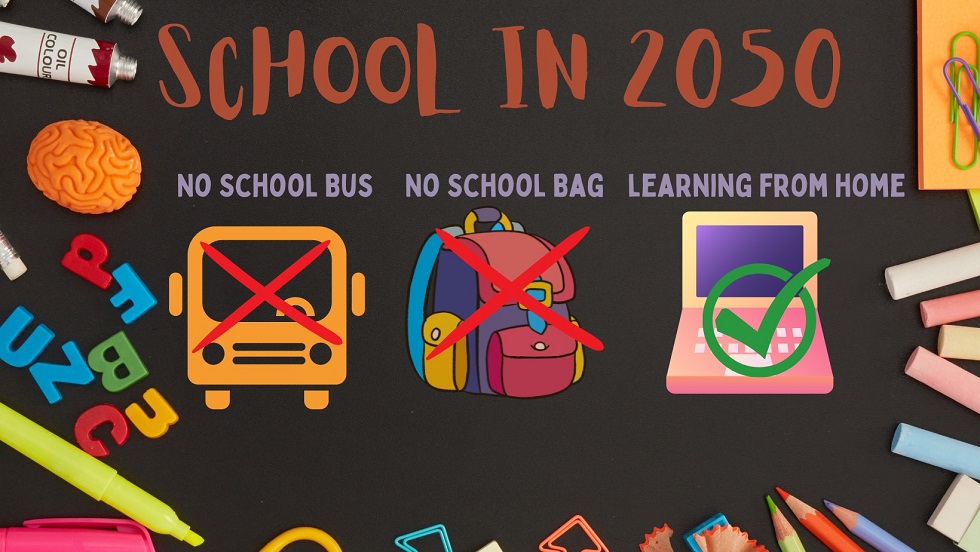
Considering the pace of technological advancement, it won’t be surprising if, by 2050, at least 90 per cent of the student population is pursuing online educational programs.
This will include online schooling as well. Online schools will truly democratise education, where every student can get a quality education irrespective of their circumstances or limitations.
Here are some anticipated characteristics of school education in 2050.
1. Personalised curriculum
With Artificial Intelligence gaining more momentum, the curriculum will be personalised to the needs of a particular student and their ability. Unlike today’s schooling environment, a one-size-fits-all approach will not be used. For example, if some children are weak in Science, they will be given more material and focus on strengthening the foundation. In today’s schools, this is impossible because the teacher has to maintain her pace for the sake of the larger group. In such a situation, if a student is unable to understand something, the only option they are left with is proactively asking doubts to the teacher or joining an extra class. In both cases, there is no guarantee that the student will get the required understanding. In online schools of 2050, AI will be able to identify students’ exact strengths and weaknesses and work to improve on them.
2. Reduced fees
One of the biggest hurdles in accessing high-quality school education is the fee structure. Most reputed schools demand exorbitant fees out of budget for most parents. Parents also have a limited choice concerning the board they want to choose for their children. We all know how school fees are highly correlated with the education board they are associated with. Parents should have the choice to give the quality of education they want for their children without having to empty their pockets. With online schooling, school fees will not have the expensive components of development costs, lab fees, etc. Technological costs will be associated; however, the cost can be optimised due to economies of scale. This can ultimately result in reduced fees for students, thus making school education more affordable and accessible to everyone.
3. Choice of curriculum
In traditional schooling, students undergo more than 12 years of school education without understanding why they are learning the chosen subjects. In most cases, students and parents don’t have a choice concerning the curriculum. Parents don’t want their children to be left out. They ensure they get the minimum qualifications required to pursue any regular career. As a result, most children feel disinterested in studies because there is no affinity towards the subjects they are supposed to learn. With online schooling, the implementation of a customised curriculum will be possible. Going by the current trends, more people will start pursuing skill-based careers rather than traditional careers where you need college degrees. For example, children can begin learning how to write from a young age without pursuing traditional degrees like engineering, graduate courses, and other time-consuming courses. With online schooling, students can also take a break and contemplate their choice of studies rather than follow the standard schedule suited to a larger group.
4. Homeschooling will be the new normal
Homeschooling is more common in the West rather than in India. Even today, we hardly get to hear any child being homeschooled. If we all hear such a case, the parents are usually well off, can afford to hire private tutors, and have other exceptional situations. Though homeschooling has its benefits, parents are sceptical about following this path. Moreover, though the pandemic made people comfortable with online schooling, offline schools are still preferred. It will take some time for people to be more pleased with online schools and homeschools. By 2050, the bias will be removed entirely from parents’ minds since technology will ensure access to higher quality education.
5. Project-Based Learning
In traditional schools, much focus is still on completing the syllabus and conducting exams. With online schooling, since the content will always be available to learners, more emphasis can be put on deriving the learning outcomes. Projects are the best way to get better learning outcomes and test them.
6. Greater focus on socio-emotional development
Even today, people have started realising the benefits of emotional quotient. A high EQ is essential to maintaining a high intelligence quotient to thrive in today’s workplace. By 2050, this thought process will be more established. Moreover, with online schooling, where the burden of completing the syllabus and giving strenuous exams is reduced, schools can provide more attention to soft skills development.
7. Parents will have the biggest role in school education
Parents will play a bigger role than anyone else since online schooling primarily occurs at home. The parent will have greater visibility into their child’s education and progress. They will play a more active role in ensuring their child learns what they need to.
There are numerous known and hidden challenges that the school education ecosystem will have to overcome between now and 2050. Whatever the future holds, we all must strive to improve the quality and access to quality education. All stakeholders, including school owners, parents, and teachers, must explore new tools and methods to better understand children’s learning needs and help fulfil those. Online schooling is one of the fastest ways to ensure a better future for our students.
Online schools like 21K Schools revolutionise future learning by offering transparent and excellent quality education, regardless of your situation and location and ensuring that your child receives the highest standard of education by teachers.