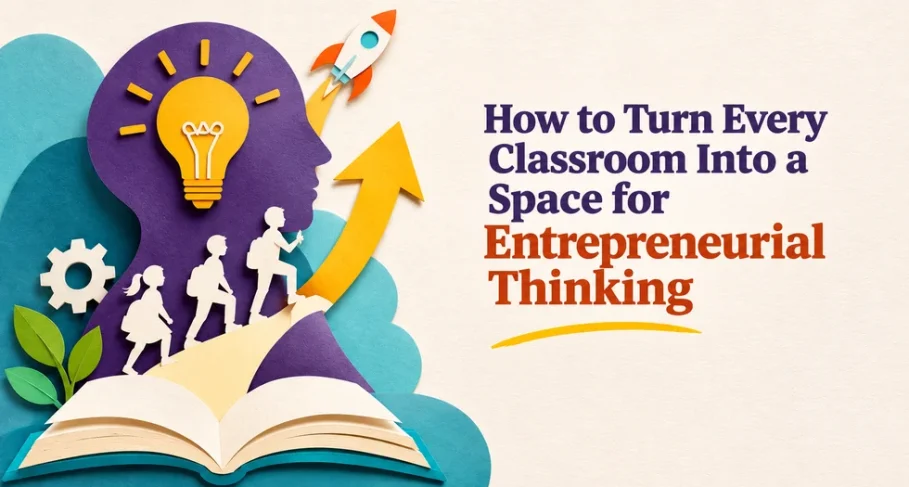
Entrepreneurship rarely begins with a business plan. It starts when the learner perceives a challenge and enquires how it can be addressed differently. An inefficient process, a waste of resources, or a community challenge can become a valuable learning experience. School systems can take advantage of such experiences to foster initiative, creativity, collaboration, problem solving, and prudent risks. Entrepreneurial thinking, therefore, does not need to sit outside regular academics. It can become part of everyday classroom practice.
India’s education policy already creates space for this approach. The National Education Policy (NEP) 2020 focuses on experiential, inquiry-based, and application-based learning [1]. It also stresses critical thinking, creativity, vocational exposure, multidisciplinary learning, and choice for students. The challenge lies in the actualization of these ideals. Current initiatives and policies should link more closely to classroom experiences.
Start With Problems, Not Business Ideas
Teachers could start with issues that students would relate to in real-life situations. In a science class, teachers can make projects on domestic garbage or water use. In mathematics, teachers could explore the concepts of budgeting, pricing, and resource allocation through real-life experiences. In languages, students can conduct interviews and present the results.
This approach keeps academic learning intact while giving students a reason to apply knowledge. Entrepreneurial thinking then becomes a method of learning rather than another subject or activity.
Use Existing Government Initiatives More Effectively
India already has substantial infrastructure for developing student innovation. Atal Innovation Mission has established 10,000 Atal Tinkering Labs across 35 States and Union Territories [2]. More than 1.1 crore students have engaged with these labs, generating over 16 lakh innovation projects [3].
The opportunity now is to connect these initiatives more closely with curriculum learning. Teachers can use ATL projects to help students research local needs, develop prototypes, test ideas, analyse evidence, and improve solutions. School Innovation Marathon activities can similarly become extensions of classroom inquiry rather than occasional competitions.
Make NEP Provisions Part of Regular Learning
NEP 2020 encourages experiential learning across subjects and gives greater importance to vocational education and student choice. Samagra Shiksha supports vocational exposure from the middle grades, along with activity-based learning, bagless days, and opportunities to engage with local vocational experts [4].
Schools can use these provisions throughout the academic year instead of treating them as isolated activities. A sustainability project, for example, can combine science, mathematics, economics, communication, and technology while addressing a real community concern.
Strengthen the Teacher’s Role
Entrepreneurial classrooms depend on teachers who can facilitate open-ended learning. Teachers require assistance in designing projects, facilitating inquiry, assessing student thinking and helping students learn from failure.
The PM SHRI framework understands continuous professional development of teachers and promotes training in innovative teaching methods and 21st-century skills [5]. Creating better communities of teacher learners can be an outcome of such a framework. Teachers can collaborate to develop project ideas, analyse student projects and improve classroom practice.
Connect Classrooms With Local Ecosystems
Understanding of entrepreneurial thinking is more concrete for students when they interact with people who are solving real-world problems. Local entrepreneurs, craftsmen, professionals, alumni and community organizations can help in this regard.
The PM SHRI framework encourages schools to connect with local entrepreneurial ecosystems. The approach can extend beyond PM SHRI schools through modest community partnerships [5]. NITI Aayog’s 2026 school education roadmap also recommends stronger school-industry partnerships, experiential skill exposure, and greater convergence among existing schemes.
Assess Thinking, Not Just Outcomes
A student project should not be judged only by whether the final idea succeeds. Schools can assess how students identify problems, gather evidence, collaborate, explain decisions, respond to feedback, and revise their solutions. Such assessment can complement competency-based approaches by giving teachers evidence of student reasoning, initiative, communication, and adaptability rather than measuring only the polish of a final product. This shift can make classroom assessment more meaningful and responsive.
This approach supports the wider skills that employers increasingly value. The World Economic Forum’s Future of Jobs Report 2025 identifies analytical thinking as the leading core skill, alongside creative thinking, resilience, flexibility, curiosity, and leadership [6].
Move From Programmes to Culture
India does not necessarily need another standalone entrepreneurship programme in every school. It needs stronger implementation of the opportunities already available through NEP 2020, Atal Innovation Mission, Samagra Shiksha, PM SHRI, vocational education, and related innovation initiatives.
The next step is to connect these provisions with everyday teaching, teacher development, assessment, and local partnerships. A student does not need to launch a company to think entrepreneurially. Students need opportunities to notice problems, ask better questions, test ideas, learn from setbacks, and create useful solutions.
When these habits become part of classroom culture, entrepreneurship becomes more than a career pathway. It becomes a practical way for students to learn, think, and contribute to society.
References
[1] National Education Policy 2020: https://static.pib.gov.in/WriteReadData/userfiles/NEP_Final_English_0.pdf
[2] Atal Tinkering Labs: https://aim.gov.in/atl.php
[3] From Classrooms to Creation Labs: https://www.pib.gov.in/PressReleasePage.aspx?PRID=2199237®=3&lang=1
[4] National Education Policy (NEP), 2020: https://www.pib.gov.in/PressReleasePage.aspx?PRID=2291276®=1&lang=1
[5] Every School, A Model School: https://www.pib.gov.in/PressReleasePage.aspx?PRID=2308156®=48&lang=2
[6] The Future of Jobs Report 2025: https://www.weforum.org/publications/the-future-of-jobs-report-2025